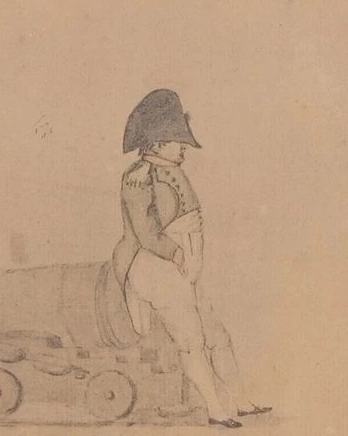
It was Sir Henry Bunbury who broke the official news to Napoleon that he was to be exiled to St Helena. This took place onboard the Bellerophon on 31 July 1815. Bunbury was an observant man and left a detailed account of the meeting, plus also a fascinating description of Napoleon’s person. It is probably one of the best verbal sketches of what Napoleon looked like during those fateful days. The account was published in the Memoir and literary remains of Lieutenant-General Sir Henry Edward Bunbury, published by his son in 1868, but this text differs slightly from the manuscript notes Bunbury made on the day or very shortly afterwards. I have noted how the manuscript (now in the Suffolk Archives) phrases things in square brackets. The description of Napoleon’s suite is, for example, radically different.
“Napoleon appears to be about five feet six inches high. His make is very stout and muscular. His neck is short, and his head rather large; it is particularly square and full about the jaw, and he has a good deal of double chin. He is bald about the temples, and the hair on the upper part of his head is very thin, but long and ragged, looking as if it was seldom [combed or] brushed. In the management of his limbs [and postures] Napoleon [Buonaparte] is ungraceful; but he used very little gesture, and the carriage [the air] of his head is dignified. He is fat and his belly projects; but this is rendered more apparent [but this is made to appear more prominent] by the make of his coat, which has very short lapels turned back, and it is hooked tight over the breast to the pit of the stomach, and is there cut away suddenly, leaving a great display of white waistcoat. He wore a green uniform with scarlet collar and scarlet edging to the lapels, but without lace or embroidery; small gilt buttons, and gold epaulettes. He had a white neckcloth, white waistcoat and breeches, silk stockings, and shoes with small gilt buckles, a very small old-fashioned sword, with a worked gold hilt buckled tight to his hip. He wore the ribbon of the Legion of Honour over his waistcoat, and the star, in silver embroidery, on his coat. There were [He had] also three very small orders hanging together at one of his buttonholes. His hat, which he carried most of the time under his arm, was rather large, quite plain and having an extremely small tricolor cockade.
Napoleon [Buonaparte] took snuff frequently during the interview; the box was not showy [fine to the eye]; it was rather long, and appeared to have four coins or medals set in its top. I was with him nearly three quarters of an hour; and (excepting about ten minutes at the commencement, while I was translating to him the paper containing the decision of government). Napoleon [Buonaparte] was speaking nearly the whole time. He spoke in a low, soft voice [but not at all tremulous], [he appeared perfectly calm throughout] and like one who could [who had the habitual] command [of] all his feelings. Nothing could be more mild and bland than the countenance he wore, and there was something particularly agreeable in its expression. Yet, in the course of his long talking I observed changes both in his tone and look, which made me suspect that there was a good deal of the fox as well as of the lion in the composition of the great conqueror. (Note: this text in italics does not appear in the original manuscript.)
Napoleon’s [Buonaparte’s] eyes are grey, the pupils rather large, not much eyebrow; hair brown; complexion sallow and the flesh sodden. His nose is finely formed [handsome], his upper lip very short and the mouth beautiful. His teeth are bad and dirty, but he shows them very little. The general character of his countenance was grave and almost melancholy; but no trace of severity or violent passion [violence] was allowed to appear . I have seldom seen a man of a stronger make, or better fitted [calculated] to endure fatigue. The principal attendants on Napoleon were the following:
Bertrand: his manners gentlemanlike, his countenance grave and thoughtful. [Has nothing particular in his appearance; middle sized, black eyes and hair]
Savary: a handsome man, but with something sinister in the working of his countenance. His manner restless and betokening the fears which were excited by the knowledge that he was one of those proscribed by Louis XVIII. [tall with a noble air and a very handsome Italian face; being dark. There is however a bad expression in his countenance when he converses and grows animated.]
L’Allemand: likewise under proscription , a thickset man, coarse in his appearance, and sullenly determined in his looks. [a thick-set man of middle stature; looks not at all like a gentleman and but little like a soldier.]
Montholon: rather insignificant. [Has nothing particular in his look or gait.]
Las Casas: not far removed from being a little old quiz ; nervous and fidgety. [A very little man; a great quiz and apparently frightened out of his wits.]
Gourgaud: a youngish man, with a smart genteel air, and somewhat of a coxcomb.[A smart Frenchman with a clever countenance and coxcombical in his dress and appearance.]
[Madame Bertrand: a tall woman, extremely thin with fair black eyes; but she looks miserable and worn to death’s door. She tried to throw herself overboard the next night.]
[Madame Montholon is a prettyish little thorough French woman but does not look like a woman of rank or fashion.]”